How AI Search Decides What to Cite: The Mechanism Behind AI Answers
On this page
- What Does It Mean for AI Search to Cite a Source?
- How AI Search Chooses Sources: The Four-Stage Pipeline
- Why Does the Way AI Search Chooses Sources Differ by Engine?
- Why Doesn't One Strong Page Win a Citation on Its Own?
- What Actually Wins at the Passage Level?
- Why Doesn't Any of This Matter Without the Technical Floor?
- Where Should You Start?
- Frequently Asked Questions
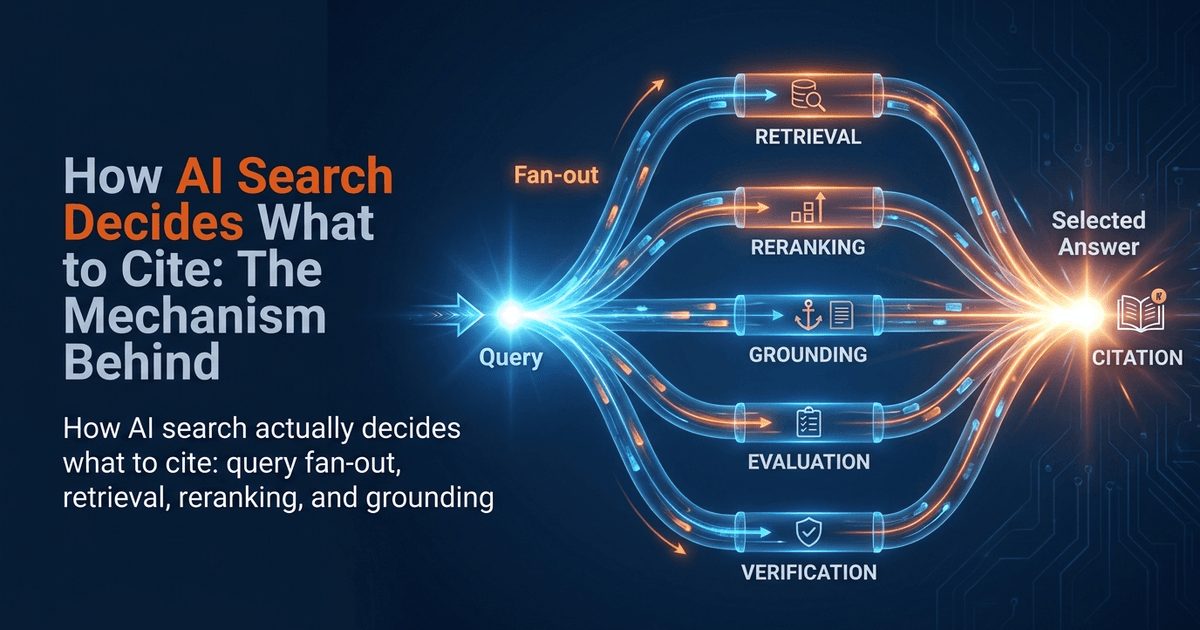
How AI search chooses sources comes down to four steps that repeat every time an engine answers a question: it splits the question into narrower sub-queries (fan-out), pulls candidate passages for each one from live search, training memory, or both (retrieval), scores those passages against the specific sub-query (reranking), then builds its answer from the passages that win and attaches a citation to each one (grounding). Being cited is not the same as ranking well on Google. The page that earns the citation is the page holding the single best passage for a narrow sub-query, not necessarily the page Google lists first, which is why two competitors can rank identically and still see very different citation rates across ChatGPT, Perplexity, and Google AI Overviews.
Key takeaways
- Every AI answer starts with fan-out: one question becomes several narrower sub-queries before anything is retrieved, so a single page gets judged several times, not once.
- Ranking and citation are different games: only around 12 percent of the URLs cited by ChatGPT, Gemini, and Copilot also rank in Google's top 10 for the same prompt, according to an Ahrefs analysis of 15,000 prompts.
- Reranking scores individual passages against a specific sub-query, not a whole page, so one well-written paragraph on an otherwise ordinary page can out-cite a larger competitor page.
- Independent, earned sources dominate what gets cited: earned media, not brand-owned content, accounts for 84 percent of AI citations, according to Muck Rack's May 2026 analysis of more than 25 million cited links.
- Off-site presence compounds: brands in the top quartile for web mentions average 169 AI Overview mentions, over 10 times the 14 mentions the next quartile down averages, according to an Ahrefs study of 75,000 brands.
What Does It Mean for AI Search to Cite a Source?
Being cited means an AI engine names your page as the source for a specific claim in its answer. It is not the same thing as ranking well for the query that prompted the answer, and the gap between the two is bigger than most marketing teams assume.
A citation is a link or attribution that an engine such as ChatGPT, Perplexity, or Google AI Overviews attaches to a specific passage it used to build its answer. Ranking, by contrast, is a position on a traditional results page. A page can sit first on Google and never get cited in an AI answer. A page several positions down can get cited if it happens to hold the best passage for a given sub-query.
That gap is measurable. Only around 12 percent of the URLs cited by ChatGPT, Gemini, and Copilot also rank in Google's top 10 for the exact same prompt, according to an Ahrefs analysis of 15,000 prompts. Put another way, roughly 88 percent of the URLs these assistants cite do not rank anywhere in Google's top 10 for the query that produced the citation. Perplexity behaves differently from the others: closer to a third of its citations point to pages that do rank in the top 10, since it searches live for nearly every query rather than leaning on training memory first.
Citation is also narrower than simply being named. An AI answer can mention a brand in passing, generated from general knowledge, with no source link attached at all. A citation specifically means the engine points to your page as where it got a claim. Brand mentions are worth tracking, but they are a different signal from source attribution, which is the mechanism this pillar is built around.
This gap is why a Google-first content strategy is not automatically an AI-citation strategy, and why generative engine optimisation is its own discipline rather than a subset of SEO. Four stages run every time someone asks an AI engine a question, and they are what produce that gap.
How AI Search Chooses Sources: The Four-Stage Pipeline
An AI engine decides what to cite through four stages that run in sequence: fan-out, retrieval, reranking, and grounding. Each stage narrows the field, from one open-ended question down to the handful of passages that make it into the final answer.
| Stage | What happens | Where it is covered in depth |
|---|---|---|
| Fan-out | The engine splits one prompt into several sub-queries before it retrieves anything | Per-Engine GEO Playbooks pillar |
| Retrieval | Each sub-query pulls candidate passages, from live web search, training memory, or both, depending on the engine | Per-Engine GEO Playbooks pillar |
| Reranking | Candidate passages are scored against the specific sub-query, not the page as a whole | Content and Entity Optimisation pillar |
| Grounding | The answer is assembled from the winning passages, and citations attach to those exact passages | Content and Entity Optimisation pillar |
Fan-out happens before a marketing team ever sees a result. The engine rewrites the original question into several narrower sub-queries, each aimed at a different facet of what was asked. Ask an AI engine to compare two categories of software and it may quietly generate separate sub-queries for pricing, integrations, and reviews before it retrieves a single passage.
Retrieval is where each of those sub-queries goes looking for candidates. Some engines retrieve almost entirely from a live web search. Others lean first on what they already learned during training and only search the web when their own memory looks insufficient. That difference in retrieval behaviour is the main reason a brand can be well cited in one engine and invisible in another, and it is covered engine by engine in the Per-Engine GEO Playbooks pillar.
Reranking decides the winners among whatever retrieval pulled back. A reranker scores each candidate passage against the specific sub-query it is trying to answer, not against the page's overall authority or Google position.
Passage-level structure, not page-level polish, is what decides who gets the citation.
This is why a single well-written paragraph, sitting on an otherwise average page, can out-cite a larger competitor page. The full set of on-page techniques that make a passage win more often, structure, entity naming, and passage design, is covered in the Content and Entity Optimisation pillar.
Grounding is the assembly step. The engine composes its answer from the passages that won reranking and attaches a citation to each one at the point it is used. This is why citations in an AI answer point to specific pages for specific claims, rather than to one source for the whole topic, and why a brand can be cited for one claim while a competitor is cited for the next claim in the same answer.
Why Does the Way AI Search Chooses Sources Differ by Engine?
Different engines cite different sources because they retrieve differently, not because one is more sophisticated than another. The retrieval step in the four-stage pipeline varies enough by engine that the same brand can see meaningfully different citation rates in ChatGPT, Perplexity, and Google AI Overviews for the same underlying topic.
| Engine | How it retrieves | What it tends to favour |
|---|---|---|
| ChatGPT | Leans on training data first; activates live search selectively | High-authority references such as Wikipedia when it does search |
| Perplexity | Searches live for essentially every query | Sources with their own clear citations; always shows what it used |
| Google AI Overviews | Stays grounded in Google's own index | Official brand sites and YouTube for many query types |
This engine-by-engine sketch is a preview, not the full manual. A fuller breakdown, including how to test what each engine currently cites for your category, lives in the Per-Engine GEO Playbooks pillar.
Why Doesn't One Strong Page Win a Citation on Its Own?
One strong page rarely wins a citation alone because AI engines look for agreement across independent sources before they cite anything with confidence. A single well-optimised page under your control is treated as one data point among many, not the final word.
This pattern, needing agreement across independent sources before citing with confidence, is what we call the consensus signal. Before an engine attaches a citation, it tends to weigh whether independent sources such as Reddit threads, review sites, YouTube, and press coverage broadly agree with what a brand's own site says. The more independent agreement it finds, the more confidently it cites.
Independent sources dominate that agreement. In a May 2026 analysis of more than 25 million links cited across ChatGPT, Claude, and Gemini spanning 17 industries, Muck Rack found that earned media, meaning non-paid, non-brand-owned sources, accounts for 84 percent of AI citations. Paid and advertorial content accounted for just 0.3 percent.
Off-site presence is not an optional extra to a citation strategy. It is roughly half the mechanism.
Web mentions compound with scale too. In a study of 75,000 brands, Ahrefs found that brands in the top quartile for web mentions average 169 mentions in Google AI Overviews, over 10 times the 14 mentions the next quartile down averages. Brand web mentions correlated with AI Overview visibility more strongly than any other factor Ahrefs tested, including backlinks.
In practice, publishing the right content on your own site is necessary but not sufficient. Being mentioned and reviewed independently is roughly half the citation mechanism, not a nice-to-have layered on top of it. The tactics for earning that third-party presence deliberately, rather than hoping it accumulates, live in the Off-Site Citation Building pillar.
What Actually Wins at the Passage Level?
At the passage level, rerankers favour text that opens with the answer over text that builds up to it, and they favour extractable formats, meaning definitions, numbers, comparisons, and step lists, over narrative prose.
A passage that opens with a direct, complete answer to its implicit question gives a reranker something it can lift with no further processing. A passage that opens with background or a rhetorical question before answering gives the reranker more work to extract the same fact, and reducing that work is exactly what reranking is built to do. Format compounds this: a comparison rendered as a table, or a process rendered as a numbered list, is structurally easier for a model to parse and quote than the same information spread across three paragraphs.
This is not exotic advice. It follows directly from the mechanism: retrieval and reranking evaluate passages, not pages, so each passage has to stand on its own. The full set of on-page techniques that make a passage win more often is covered in the Content and Entity Optimisation pillar.
Why Doesn't Any of This Matter Without the Technical Floor?
None of the fan-out, retrieval, reranking, or consensus mechanics in this pipeline matter if an AI crawler cannot reach or parse your page in the first place. Technical access is the floor the rest of the pipeline is built on, not a differentiator once you clear it.
Schema markup that describes what a page is, open access for the crawlers each engine uses, and rendering that does not hide content behind client-side JavaScript, are prerequisites. Get them wrong and a page can hold the best passage on the internet for a given sub-query and never be retrieved at all. Get them right and you are, at best, level with every other page that also cleared the floor; the real competition happens at reranking. This layer is covered in full in the Technical AI Crawlability pillar.
Where Should You Start?
Start by measuring, not publishing. Before rewriting a single page, find out which sub-queries in your category already cite a competitor, so you know where the actual gap is instead of guessing.
Measuring first is the sequencing behind ScaleCraft's Answer Engine Method: Measure, Optimise, Amplify, Track. Measurement comes first because the four-stage fan-out-to-grounding pipeline means citation gaps are sub-query specific, not topic specific; a brand can be well cited on one facet of a question and invisible on the next facet of the same answer. Optimise and Amplify correspond to the Content and Entity Optimisation and Off-Site Citation Building pillars. Track corresponds to the AI Visibility Measurement pillar, which tells you whether any of it moved your share of voice.
Related guides. This pillar is the index, not the manual. The Per-Engine GEO Playbooks pillar goes deep on how ChatGPT, Perplexity, and Google AI Overviews each retrieve and favour sources. The Content and Entity Optimisation pillar covers passage-level structure and entity naming in full. The Off-Site Citation Building pillar covers how to earn the independent mentions the consensus signal rewards. The Technical AI Crawlability pillar covers the schema, access, and rendering prerequisites. The AI Visibility Measurement pillar covers how to track whether any of this is working.
We're early at ScaleCraft, and we say so plainly. We would rather show you an honest, measured share-of-voice number than promise one.
Get a free AI Visibility Audit to see which sub-queries in your category already cite a competitor.
Frequently Asked Questions
What is query fan-out in AI search?
Query fan-out is the step where an AI engine splits one prompt into several narrower sub-queries before it retrieves anything, each aimed at a different facet of the original question. It happens before retrieval, which is why a page rarely gets just one shot at being found; it gets evaluated against several sub-queries drawn from the same prompt.
Why does ChatGPT cite different sources than Google AI Overviews?
ChatGPT and Google AI Overviews retrieve differently. ChatGPT leans on its training data first and activates live web search selectively, favouring high-authority references such as Wikipedia when it does search. Google AI Overviews stays grounded in Google's own index and favours official brand sites and YouTube for many query types. Different retrieval behaviour produces different citation patterns even for the same underlying topic.
Does a page need to rank number one on Google to be cited by AI?
No. Only around 12 percent of the URLs cited by ChatGPT, Gemini, and Copilot also rank in Google's top 10 for the same prompt, according to an Ahrefs analysis of 15,000 prompts. Citation depends on whether a specific passage wins reranking for a specific sub-query, not on the page's overall Google ranking.
What is retrieval-augmented generation (RAG)?
Retrieval-augmented generation is the general technique behind the retrieval and grounding stages in an AI search pipeline: an AI system retrieves relevant passages from an external source, such as live search results or a document index, rather than relying only on what it learned during training, then grounds its generated answer in those retrieved passages and cites them.